Stemann Consulting
DMADV FOR END-TO-END PRODUCT AND PROCESS DEVELOPMENT

Design for Six Sigma Training

Many companies already have a clearly defined Product Development Process with phases, deliverables, reviews and gates. The challenge often lies not in the process itself, but in the methodological execution within the individual development phases

Our Design for Six Sigma Training shows how DMADV systematically complements the existing PDP – from clarifying the development assignment and making concept and design decisions through verification and handover to production

30 clearly structured steps create a continuous thread for evidence-based technical decisions.

Design for Six Sigma Training – Stemann Consulting
Training overview

DMADV as a methodological extension of your existing Product Development Process

A good Product Development Process defines phases, milestones, responsibilities and gates. What is often missing is a consistent methodological logic connecting these points

This is where DMADV adds value. The 30-step roadmap links requirements, technical concepts, risks, design decisions, experiments, robustness considerations and verification into a traceable development path

The objective is not to replace an existing PDP or create additional bureaucracy

DMADV provides the methods and decision logic where development projects require technical confidence and reliable evidence.

Integrate DMADV effectively into the existing PDP
Make development decisions in a structured, evidence-based way
Identify risks and critical design parameters at an early stage
Develop robust products and processes and verify them systematically
Curriculum

Training content and agenda

  1. 01

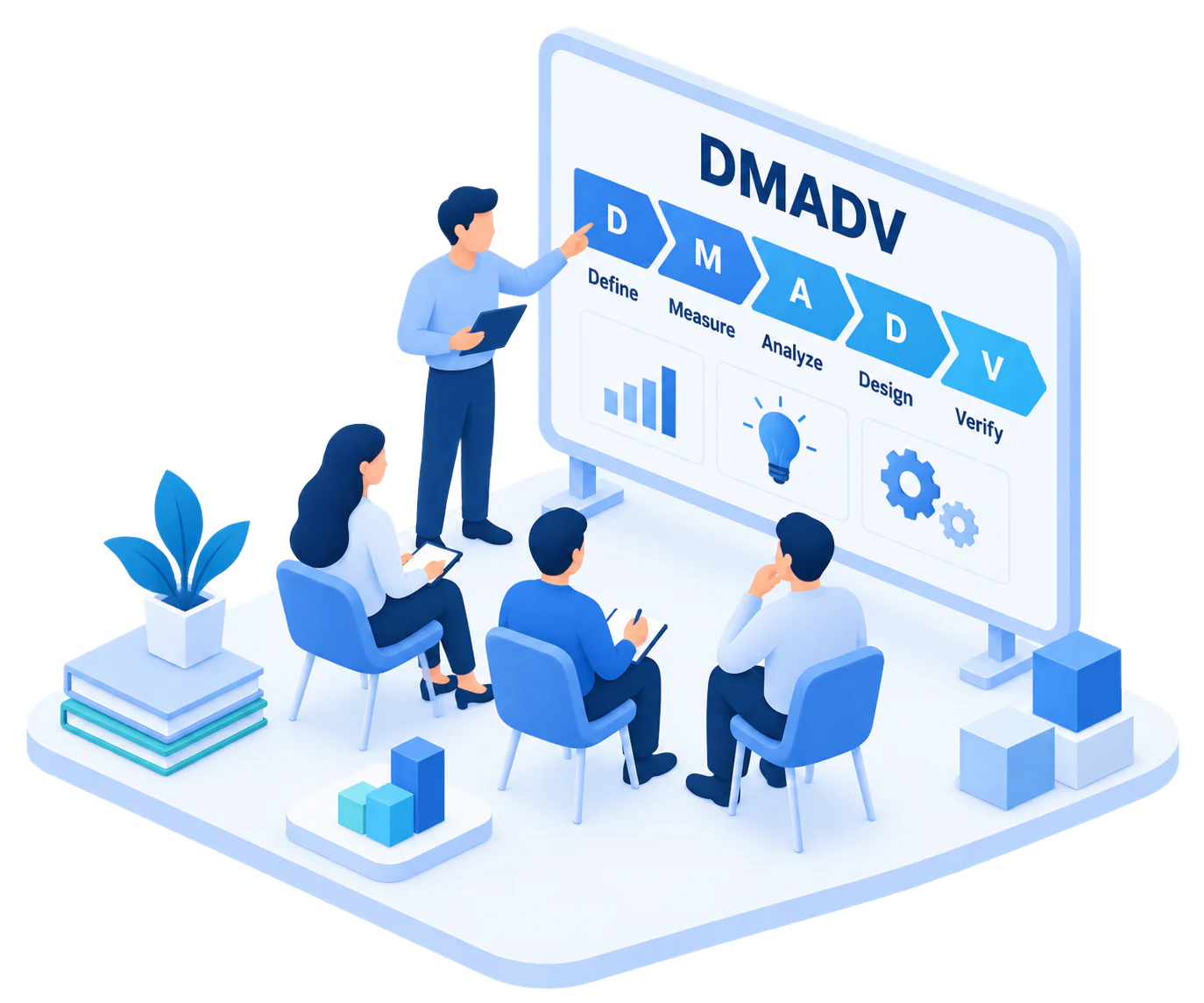
    Define – Clarify the development assignment, objectives and project boundaries, involve stakeholders and position DMADV within the existing PDP

  2. 02

    Measure – Operationalise requirements, use available data and experience, assess risks and establish a reliable development baseline

  3. 03

    Analyze – Analyse functions, concepts and technical relationships, evaluate alternatives and identify critical influencing factors

  4. 04

    Design – Develop product and process designs systematically, validate them experimentally, optimise them and make them robust against real-world variation

  5. 05

    Verify – Verify the design and process under realistic conditions, demonstrate performance and reliability, and secure the handover to production

Depending on the development task, methods such as QFD, FMEA, Design of Experiments, regression, simulation, tolerance analysis and Robust Design are applied where they add value.

Target group

Who is this training for?

The training is designed for professionals and leaders who want to make product and process development more methodical, evidence-based and consistent.

  • Project leaders and owners in product and process development projects
  • Development, quality and manufacturing engineers
  • Professionals responsible for Product Development Processes, industrialization and launch
  • Technical project teams that want to support development decisions with stronger evidence
  • Method experts integrating DMADV into existing development processes

DMADV Roadmap

30 steps as a continuous thread through development

The DMADV roadmap translates the five phases into 30 concrete working steps. This turns a general framework into a practical development process. Each step addresses a central project question and connects the required inputs, outputs and suitable methods with the relevant development decision.

This creates a continuous connection from the development assignment through product and process design to verification and handover to production.

The existing PDP remains the organisational framework – the DMADV roadmap provides the methodological depth.
DEFINE

1 step

01 – 01
01Define and plan the development project
Training calendar

Upcoming public dates

16Nov

Hagen

16.11.2026 – 18.11.2026

On-site | 16 seats
Registration openRequest a place
22Feb

Stuttgart

22.02.2027 – 24.02.2027

On-site | 16 seats
Registration openRequest a place
14Jun

Online

14.06.2027 – 16.06.2027

Online | 16 seats
Registration openRequest a place
Quality & certificate

Quality assurance & certificate

The focus is on a consistent development logic, not on applying as many tools as possible. A good PDP defines what must be achieved and when. DMADV complements this framework with the methodological depth required to make technical decisions traceable, evidence-based and robust

FAQ

Frequently asked questions

What is Design for Six Sigma and what does DMADV mean?

Design for Six Sigma supports the robust development of new products, processes and systems. DMADV stands for Define, Measure, Analyze, Design and Verify and structures the methodological work from customer requirements through verification

Does DMADV replace our existing product development process?

No. The existing Product Development Process remains the project-management and governance framework. DMADV adds methodological depth, data analysis and a traceable technical decision logic

What is the difference between DMAIC and DMADV?

DMAIC is typically used to improve existing processes systematically. DMADV focuses on developing or fundamentally redesigning products and processes so that requirements, robustness and future performance are considered from the design stage onward

Who is the Design for Six Sigma training for?

The training is designed for professionals and leaders in product and process development, engineering, quality, manufacturing, industrialization and launch, as well as method experts who want to integrate DMADV into existing development processes
Which statistical methods are covered?

Depending on the development question, the training introduces and applies methods such as Design of Experiments, regression, response surface methods, simulation, tolerance analysis, Robust Design, optimization and capability prediction

How is the three-day training structured?

The three-day training follows the development logic from Define through Verify and connects the five DMADV phases with a 30-step roadmap. Methods are used where they support a specific development decision, risk assessment or verification task

Do I need to bring my own development project?

An own project is not a formal requirement. Real product or process development examples are highly useful, however, because the methods and decision logic can be transferred directly into your existing PDP

Can the Design for Six Sigma training be customized as an in-house program?

Yes. Content, examples and methodological depth can be adapted to your existing PDP phases, gates, roles, products and development challenges