Data-Driven Sustainability Management: How SMEs Can Master the Twin Transition
15. July 2026
The simultaneous challenge of digitalization and decarbonization presents small and medium-sized enterprises with significant methodological hurdles. In practice, consistent sustainability reporting frequently fails due to heterogeneous system landscapes, a lack of data consistency, and the immense effort required to collect data along the entire value chain.
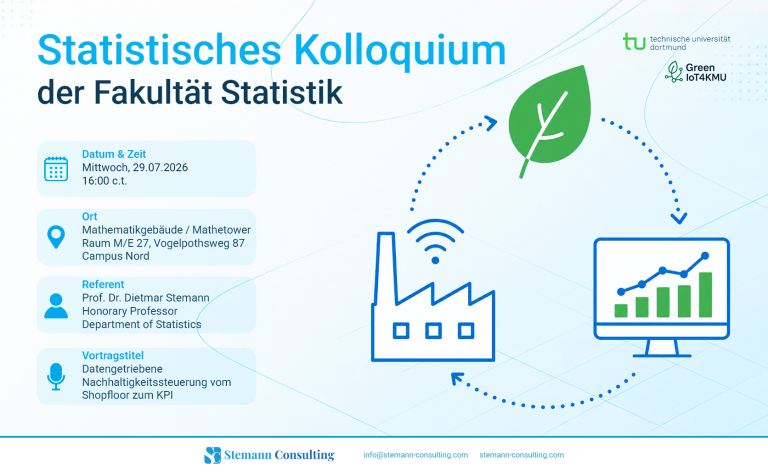
The collaborative project GreenIoT4KMU addresses this exact gap by developing an intelligent data hub that acts as a semantic translator between various operational systems. At the core of this architecture is the Green Management and Reporting System (GMRS). It enables continuous vertical data aggregation, seamlessly bridging the gap between high-frequency IoT sensors on the shop floor and strategic top-management key performance indicators.
Methodologically, this approach relies on precise structuring. The collected sensor data is consistently condensed into management-relevant reports, while ecological and economic impact relationships are visualized through detailed driver trees. Through the mathematical and logical linking of green KPIs, organizations can simultaneously optimize both their ecological footprint and their economic performance. If target deviations occur in day-to-day operations, implemented drill-down procedures immediately take effect to enable exact and targeted root-cause analysis.
This well-thought-out, data-space-compatible architecture ensures that the digital sovereignty of the companies is maintained at all times. As a result, previously isolated data streams are transformed into a precise, empirical control tool that actively drives the green transformation of the industry in North Rhine-Westphalia.
As detailed in the official document, Einladung Statistisches Kolloquium Prof. Dr. Stemann 2026 07 29-1.pdf, anyone wishing to delve deeper into this innovative methodology is warmly invited to attend the upcoming event at the Department of Statistics, TU Dortmund University. On Wednesday, July 29, 2026, Prof. Dr. Dietmar Stemann, Honorary Professor at the Department of Statistics, will give a talk on data-driven sustainability management. The event begins at 16:00 c.t. in Room E 27 of the Mathetower at Campus Nord.